Tuesday, December 1, 2015

Seed Collecting for Biodiversity and Conservation

By Sarah Leach Smith
Visitor Services Coordinator

It was a cool, gray day in late October. Leaves were starting to change color, there were more seed heads than blooms in the Gardens and the morning was chilly enough that I needed a jacket. While this may be prime time for hot chocolate and fluffy scarves, it is also the optimal time for seed-collecting in central North Carolina.

On this day, I excitedly joined Horticulturist Annabel Renwick and Plant Collections Manager Beth Hall on a seed-collecting trip around Orange County. They were gathering native plant seeds for use in the new Piedmont Prairie, located in the Blomquist Garden of Native Plants. I had no idea what a seed-collecting trip entailed, but I was looking forward to finding out
.

We started the day in Chapel Hill, visiting our friends at the North Carolina Botanical Garden.  We had a nice time chatting with our counterparts – seed program coordinator Heather Summer, greenhouse and nursery manager Matt Gocke and curator of habitat gardens Chris Liloia – and it was a treat to briefly stroll through the gardens. The fall color is looking fantastic! Heather sent us on our way with two species of seeds we were seeking, Symphyotrichum concolor (eastern silver aster) and Clematis ochroleuca (curly heads).

Our next destination was a great hidden gem. Niche Gardens is a mail-order and retail nursery near Chapel Hill that specializes in nursery-propagated plants. They have a unique selection of wildflowers and native plants, so they were a natural stop for us on our trip. Annabel spoke with Lauri Lawson, who helped us purchase several native species: Rudbekia laciniata (cut-leaf coneflower), Symphyotrichum cordifolium (blue wood aster) and Scutellaria incana (hoary skullcap). We loaded the flats into the truck and were off.
 
For the rest of the afternoon, we cruised around rural Orange County scouting roadsides for wildflowers in seed. Armed with brown paper bags and sharpies for labeling, we walked along the road and through ditches to find our treasures.

“I was particularly excited in finding such a rich vein of wild flowers,” Annabel told me when we returned to Duke Gardens. One of the highlights of the roadside collection was finding Solidago rugosa (wrinkleleaf goldenrod) in seed. Gathering seeds can be a waiting game, Annabel said. “I have one more outing to collect seed, and I have been waiting for several flowers to go to seed.” Annabel’s wishlist includes Solidago bicolor (white goldenrod), Symphyotrichum grandiflora (large flowered aster), Symphyotrichum puniceum (purple stemmed aster) and Silphium asteriscus (starry rosinweed).

Why go to the trouble of collecting seed from roadside ditches? For Annabel, it’s important that the Piedmont Prairie has “a sense of place," she says. "We want it to contain the progeny of plants whose parents populated the roadsides of this region before there were roads.”

Additionally, growing plants from seeds ensures genetic diversity, unlike asexually-propagated cultivars. Creating a prairie landscape rich in biodiversity is one of Annabel’s primary goals.

Joining Annabel and Beth was a wonderful experience that will cause me to forever look at roadsides in a different way. We are in an area that is so rich with native plant species! We’re excited to be part of this conservation effort and hope you make time to enjoy the Piedmont Prairie on your next visit to Duke Gardens.


Monday, November 30, 2015

The Beauty of Autumn – and the Science Behind It


By Ashley Wong (T'16)

Culberson Asiatic Arboretum

Anyone who has taken a stroll through Duke Gardens within the past few weeks can resoundingly attest that fall is in full swing.

Now that the foliage has taken an autumnal turn and the air holds a pre-winter crispness, you may have wondered about the processes governing nature’s lovely color transformation that we witness at this time every year. It’s a phenomenon poignant enough to have inspired countless works of literature by writers and philosophers -- so poignant that renowned autumn-enthusiast Henry David Thoreau notably wrote an entire journal chronicling his observations of autumnal beauty as an homage to the season.


The Spring Woodland Garden

Unsurprisingly, the transformation of green leaves into sundry shades of red, orange, yellow, and brown has evolved into a particularly lucrative tourist attraction over the years. Autumn-inspired tourism, an activity so prominent that it has earned the name “leaf peeping tourism,” brings in approximately $1 billion dollars in revenue to North Carolina each year, a sizable chunk of its more than $20 billion dollar annual tourism income. Luckily for us, North Carolina seems to be a prime location for admiring fall foliage.


Blomquist Garden. Photo by Micaela Unda.
So what are the biochemical processes that lead to this revenue-boosting spectacle? Stefan Bloodworth, curator of the Blomquist Garden, recently presented a lecture on the biochemistry of fall color for Duke Gardens volunteers. He says that the onset of fall color is essentially a signal that photosynthesis has ended for the year.

As the number of daylight hours dwindles, the energy cost of photosynthesizing begins to climb, since the inputs of sunlight and warmth that are necessary for photosynthesis are no longer steadily coming in. Thus, plants are triggered to stop producing chlorophyll, which absorbs red and blue light and reflects the leafy green for us to see. In addition, the plant grows a corky membrane between the leaf and the tree, essentially cutting off support of the leaf. At this point, we begin to see pigments that have been there throughout the growing season but were masked by chlorophyll the rest of the year.

One class of pigments, carotenoids, helps enhance the annual photosynthetic process by allowing the leaf to absorb light from the blue spectrum. Carotenoids have an additional part to play as well: acting in a photoprotective role throughout the growing season. Carotenoids protect leaves by cleaning up free oxygen radicals within the leaf. Also, as the level of sunlight declines, excess energy can build up and harm the leaf; carotenoids help in dissipating that energy as heat. This class of pigments is predominantly responsible for the vibrant orange and yellow hues associated with autumn foliage. 

But what about the purple and red colors? Anthocyanins, another class of pigments, are responsible for those hues, and they also emerge after photosynthesis ends and chlorophyll is no longer present. These pigments absorb blue-green light wavelengths, allowing the red wavelengths to be visible to us as red. Anthocyanins are also integral to photoprotection, acting as light screens to modulate light absorption and minimize the damage from too much sunlight. We have these molecules to thank for our visual and emotional pleasure every autumn. 

So even as the end of fall semester approaches and work inevitably begins to pile up (mercilessly so), take a minute to step outside and absorb the brilliant autumn coloration surrounds you – believe me, it’ll be worth it.
Japanese maple in the Historic Gardens. Photo by Lori Sullivan.
Blogger Ashley Wong is a Duke senior majoring in environmental studies, with minors in biology and visual & media studies. She is also a Duke Gardens work-study marketing assistant. All photos by Ashley Wong except where noted.

Tuesday, November 17, 2015

Spotlight on: The Garden Guild


By Sarah Leach Smith

This holiday season, it’s all about local, handmade gifts. Shopping locally can seem daunting, especially when big-box stores are so easily accessible. But you don't need to look further than the Terrace Shop at Duke Gardens – here, you’ll find awesome gift ideas created with care by the Duke Gardens Garden Guild.

The Garden Guild started in the summer of 1999 to create garden-related crafts to sell at the fall plant sale to benefit Duke  Gardens. Their efforts were a great success, netting approximately $2,000 from their first sale! Since then, the Guild has become a popular fixture here at Duke Gardens.

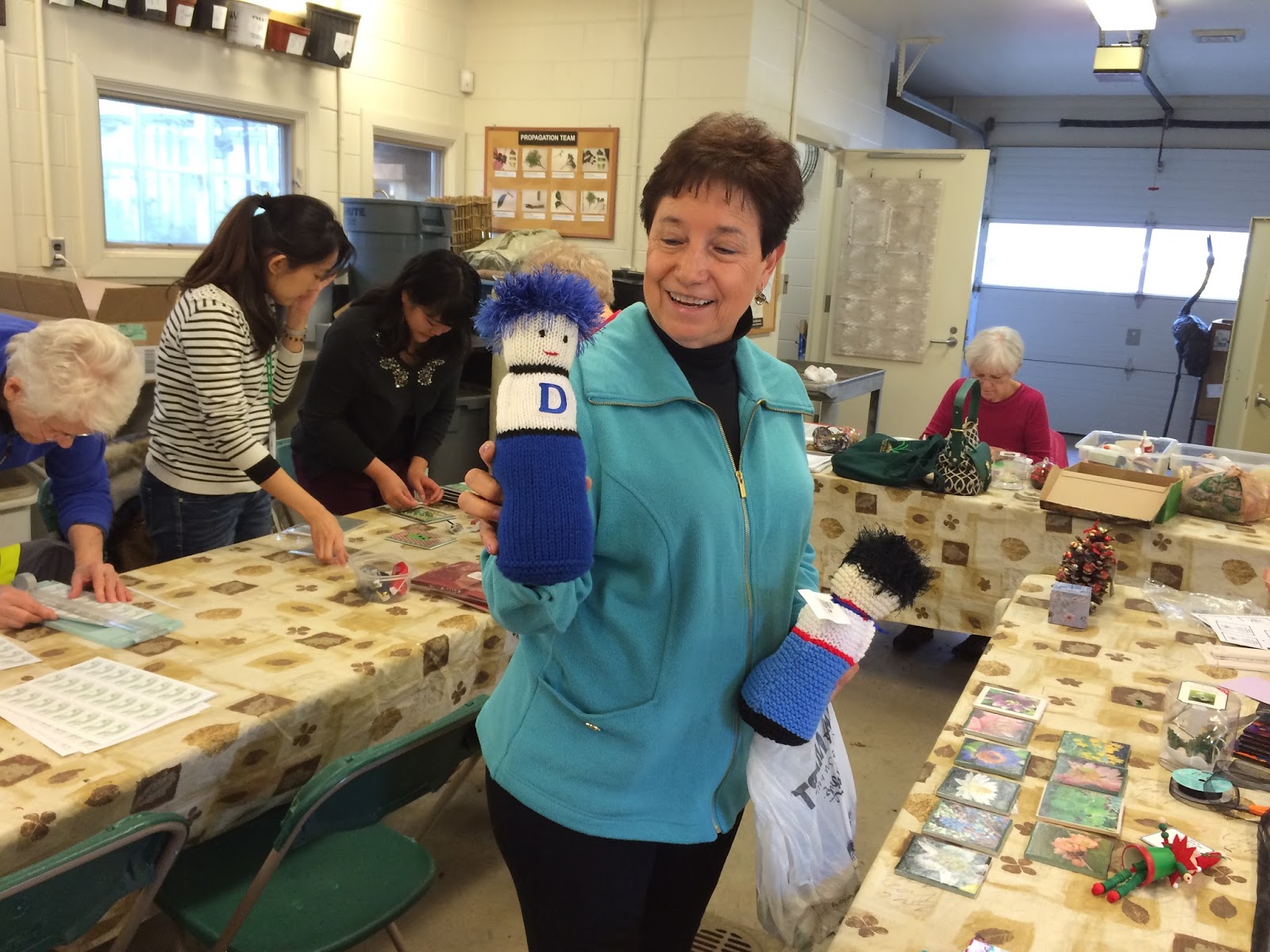
Today, the Guild has 20 active members who meet Monday afternoons at the Gardens for crafting sessions. Each member has different experiences and talents, and they teach each other new skills to create beautiful, practical and one-of-a-kind items while having a great time socializing together.

This year, in lieu of the annual craft fair, you can find their unique offerings in the Terrace Shop year round. They are presently getting ready for the holiday season with tree ornaments, note cards (sold individually and in boxed sets), ceramic angel figurines and more. 

I recently had the opportunity to spend time with the Guild during one of their crafting sessions and was floored by the creativity and originality I saw. Come out and see their wares in the Terrace Shop. You are sure to impress a friend or loved one with a thoughtful, handmade gift. The Garden Guild brings out new items often, so be sure to check back regularly.

If you are interested in getting involved with the Garden Guild, we’d love to have you. Learn more about volunteering at Duke Gardens on our website. Happy Holidays!

Tuesday, November 10, 2015

Give the Gift of Duke Gardens!


By Sarah Leach Smith
 
There’s no denying the cooler temperatures and the falling leaves – the winter holidays are approaching. For many people, it’s a stressful time of year. What will I bring to the meal/give as a gift/wear to the party? Here at Duke Gardens, we may not be able to answer ALL of your questions, but we can certainly help with a few of these things.

Have you ever considered the gift of a Friends of Duke Gardens membership? It’s a wonderful idea for people who live in Durham or the surrounding areas. Because Duke Gardens is free for all visitors, more than half of our yearly operating budget comes from our members, who value all that this botanic garden has to offer.
 
Membership not only supports the future of Duke Gardens, but it also comes with great benefits for members. All membership levels include discounts for education programs and gift shop purchases, invitations to specials Friends of Duke Gardens events, reciprocal admission to nearly 300 gardens in North America and a copy of our annual Friends publication Flora.

To supplement the gift of membership, consider a special Duke Gardens souvenir item! In the Terrace Shop, we have a beautiful assortment of Duke Gardens books, mugs, T-shirts and 2016 calendars. We also have unique items handmade by the Garden Guild, a group of very crafty Gardens volunteers. Stay tuned for more information about these items.

If you’d like to give a gift of a Friends of Duke Gardens membership, please give us a call. Development Assistant Millicent Snow would love to hear from you and may be reached at 919-668-1711.

Happy Holidays!