Showing posts with label science. Show all posts

Wednesday, January 31, 2018

Making Botany Come Alive

Gain a deeper understanding of plant parts and their roles in "Basic Botany."
Photo by Bill Snead.
Lots of people like to garden, and many appreciate a beautiful garden design, but how many know exactly how plants manage water and nutrients? What makes them grow bigger flowers or juicier fruits? If you have ever wondered about these things, consider joining us for Alec Motten's "Basic Botany and Plant Growth" class beginning on Thursday, Feb. 15, from 6-9 p.m.

Motten is a distinguished associate professor emeritus in Duke's Department of Biology, and his passion and engaging way of teaching also made him a quick favorite among Duke Gardens instructors. You'll see why if you take his class. In the meantime, Motten offered some insights about himself and his love for plants in the following email exchange from 2016:

Alec poses with a beautiful friend.
Tell us about your background and experience.
I earned my Ph.D. in zoology at Duke in 1982 and received undergraduate degrees in botany from UNC-Chapel Hill in 1970 and in zoology from the University of Washington in Seattle in 1976. I've always straddled the line between traditional botanist and zoologist designations and consider myself an equal-opportunity natural historian.

My primary responsibility at Duke has been teaching undergraduates an array of courses, including introductory biology, organismal diversity, botany, ecology, and genetics and evolution. I've also taught writing for first-year students and senior biology majors. My research interests are in evolutionary biology, pollination ecology and plant reproductive biology.

For my doctoral dissertation I studied plant-pollinator interactions in the spring wildflower community of Duke Forest. I still consider March and April my favorite time to be in the woods, and I like to lead spring wildflower hikes to local natural areas.

In my spare time, I enjoy hiking, camping and canoeing. During travels in the U.S. and abroad, I look forward to opportunities to learn the local flora and fauna and indulge my interest in wildlife and nature photography.


Learn how plants manage water in response
to the environment. Photo by Orla Swift.
What can we expect from your class, and what do you hope participants will gain from it?
Students in the class will get a whirlwind tour of basic plant biology and learn how plants are put together, how they function, grow and reproduce, and how they interact in different ways with animals. Extensive, colorful handouts will be provided to help students follow along with the many different topics we'll cover.  I'll also bring in live specimens and lots of demonstration materials for hands-on activities and student personal observations.

Although any science class necessarily includes a certain amount of jargon, I'll keep that to a minimum and make sure to explain technical terms in language accessible to a non-specialist. My experience is that folks taking this class all have some interest in plants, often from a gardening or environmental conservation perspective, and my hope is to expand on that interest by helping students make connections with aspects of plant biology they are less familiar with. Plants are often taken for granted in our society -- they can be the unnoticed "wallpaper" of our world -- and I'd like to provide a deeper appreciation of just how amazing plant biology can be.

Learn how the structures of plants attract specific 
pollinators. Photo by Annabel Renwick.
What are you most excited about in this class?
In a time when much of academia is caught up in either increasingly narrowly focused topics or trendy multi/inter/cross-disciplinary studies, it is refreshing to teach a rather more traditional subject and help students delve into it with fresh eyes and new curiosity.  I always look forward to this opportunity to share my enthusiasm for botany with willing, interested students in a largely informal, relaxed setting -- no quizzes or papers! And, without a set curriculum to cover for an exam, I like being able to go off on botanically oriented tangents as student interests and unexpected opportunities may lead. The students and I always learn something new!

Motten's class meets for four Thursday night sessions, from Feb. 15 to March 8, from 6-9 p.m. If you are interested in learning more, please check out the class description for "Basic Botany and Plant Growth" on our website. To register, please call 919-668-1707 or send us an email. We look forward to seeing you!

This article is adapted from a 2016 post by Sarah Leach Smith.

Wednesday, October 4, 2017

Classroom Open Hours teaches children and parents


Classroom Open Hours includes access to our nature museum.
Photo by Sheon Wilson
By Sheon Wilson
Publications Coordinator

A 2-foot-long wasp’s nest, beaver and coyote skulls, brilliant feathers from an Amazonian parrot—it’s not every day that a child encounters such unusual study tools.

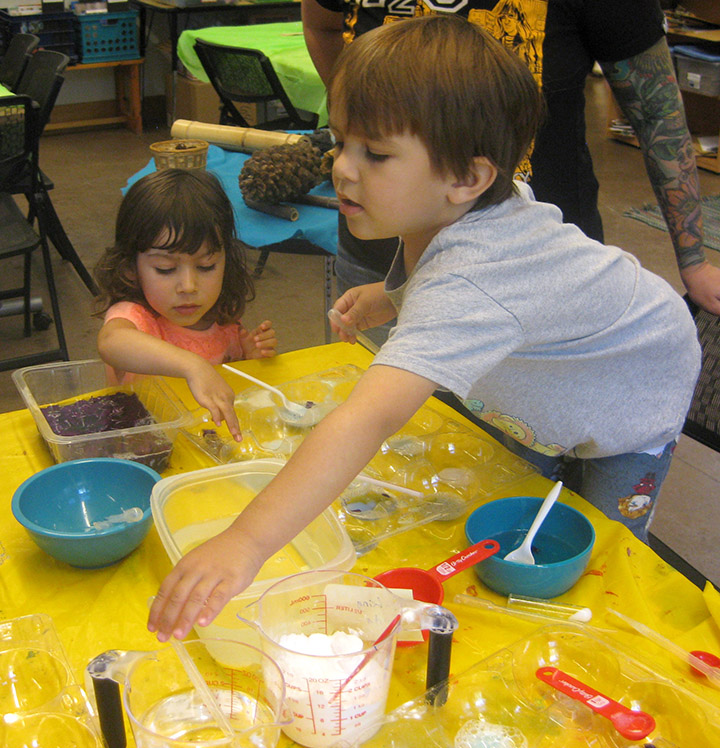
But at Duke Gardens’ weekly Classroom Open Hours, homeschool children and parents can gather for unique hands-on scientific adventures in an exciting learning laboratory.

The open-ended sessions—which run from 1 to 3 p.m. on Tuesdays through Nov. 28 and then resume from Jan. 16 to Feb. 27—give parents and children access to nature-related lesson plans, curriculum aids, microscopes, science-themed books, and a wide variety of unusual specimens and artifacts they probably don’t have at home.

“The classroom hours allow us to nurture learning and discovery in a manner that would otherwise be abstract,” says Cheznee Johnson, whose son, Harrison, attended nearly every session last year.

“Harrison has such a curiosity and interest in the world around him and how things work,” she says. “Every Tuesday he gets to see and experiment with all sorts of new and different things in the classroom.”

The sessions are unstructured so children and adults are free to explore the curiosities and find what piques their interest.

“We see it as a great way for families who can’t devote a room to all the things we have collected to have access to our resources, plus our teaching experience,” says Kati Henderson, a staff assistant in children’s education at Duke Gardens.

It's not every day you see a paper wasp nest up close.
Photo by Sheon Wilson
“Some parents have really enjoyed the experiments we do and have said, ‘Thank you for setting this up, because I wouldn’t have done this at home since it’s way too messy.’ ”

Parents struggling to create a lesson or activity for particular topics can ask the session leader for advice.

“We’ve made lesson plans for almost every discipline in our Garden programs,” Henderson says.

To prepare for a recent session, Henderson set up five tables. To appeal to preschooloers, she had materials for touching on one table, including a tub of sand and water.

Parents and children have many options to choose from
in Classroom Open Hours. Photo by Kati Henderson.
Another table had science magazines and old Duke Gardens calendars for making collages, along with an activity suggestion: Cut out a picture of an animal, create a habitat for it using more pictures and then collage them together. Nearby were boxes of cut branches for stacking and building structures. A fourth had a variety of leaves with drawing and dissecting materials for a hands-on nature study. And the table for parents had resources galore.

For students on school break, Classroom Open Hours can slow the brain-drain by infusing fun self-directed studies into their days off. It’s also popular for people seeking activities for visiting children.

“It gives the adults a bit of a break,” Henderson says. “They don’t have to choose the activity, gather the materials or plan the lesson. Because it’s drop-in, you can come when you want.”
Children love exploring our learning
lab. Photo by K. Henderson.

PROGRAM DETAILS:

DATES: Tuesdays through Nov. 28, and Jan. 16-Feb. 27

TIME: 1-3 p.m. Drop in anytime.

FEE: $3 per child per session; $40 per child or $120 per family for all sessions.

MORE INFORMATION: See our website to learn more about this and other programs for children and families, and to begin the registration process or ask questions. You may also call or email us directly at 919-668-1707 or gardenseducation@duke.edu.

Monday, November 30, 2015

The Beauty of Autumn – and the Science Behind It


By Ashley Wong (T'16)

Culberson Asiatic Arboretum

Anyone who has taken a stroll through Duke Gardens within the past few weeks can resoundingly attest that fall is in full swing.

Now that the foliage has taken an autumnal turn and the air holds a pre-winter crispness, you may have wondered about the processes governing nature’s lovely color transformation that we witness at this time every year. It’s a phenomenon poignant enough to have inspired countless works of literature by writers and philosophers -- so poignant that renowned autumn-enthusiast Henry David Thoreau notably wrote an entire journal chronicling his observations of autumnal beauty as an homage to the season.


The Spring Woodland Garden

Unsurprisingly, the transformation of green leaves into sundry shades of red, orange, yellow, and brown has evolved into a particularly lucrative tourist attraction over the years. Autumn-inspired tourism, an activity so prominent that it has earned the name “leaf peeping tourism,” brings in approximately $1 billion dollars in revenue to North Carolina each year, a sizable chunk of its more than $20 billion dollar annual tourism income. Luckily for us, North Carolina seems to be a prime location for admiring fall foliage.


Blomquist Garden. Photo by Micaela Unda.
So what are the biochemical processes that lead to this revenue-boosting spectacle? Stefan Bloodworth, curator of the Blomquist Garden, recently presented a lecture on the biochemistry of fall color for Duke Gardens volunteers. He says that the onset of fall color is essentially a signal that photosynthesis has ended for the year.

As the number of daylight hours dwindles, the energy cost of photosynthesizing begins to climb, since the inputs of sunlight and warmth that are necessary for photosynthesis are no longer steadily coming in. Thus, plants are triggered to stop producing chlorophyll, which absorbs red and blue light and reflects the leafy green for us to see. In addition, the plant grows a corky membrane between the leaf and the tree, essentially cutting off support of the leaf. At this point, we begin to see pigments that have been there throughout the growing season but were masked by chlorophyll the rest of the year.

One class of pigments, carotenoids, helps enhance the annual photosynthetic process by allowing the leaf to absorb light from the blue spectrum. Carotenoids have an additional part to play as well: acting in a photoprotective role throughout the growing season. Carotenoids protect leaves by cleaning up free oxygen radicals within the leaf. Also, as the level of sunlight declines, excess energy can build up and harm the leaf; carotenoids help in dissipating that energy as heat. This class of pigments is predominantly responsible for the vibrant orange and yellow hues associated with autumn foliage. 

But what about the purple and red colors? Anthocyanins, another class of pigments, are responsible for those hues, and they also emerge after photosynthesis ends and chlorophyll is no longer present. These pigments absorb blue-green light wavelengths, allowing the red wavelengths to be visible to us as red. Anthocyanins are also integral to photoprotection, acting as light screens to modulate light absorption and minimize the damage from too much sunlight. We have these molecules to thank for our visual and emotional pleasure every autumn. 

So even as the end of fall semester approaches and work inevitably begins to pile up (mercilessly so), take a minute to step outside and absorb the brilliant autumn coloration surrounds you – believe me, it’ll be worth it.
Japanese maple in the Historic Gardens. Photo by Lori Sullivan.
Blogger Ashley Wong is a Duke senior majoring in environmental studies, with minors in biology and visual & media studies. She is also a Duke Gardens work-study marketing assistant. All photos by Ashley Wong except where noted.

Friday, August 26, 2011

Exploring nature with children

By Jan Little

Most of us live in some kind of building, one that we call home. But in a larger sense we live in the entire world. That world can be a mysterious place, or it can feel just like home. Imagine a child’s excitement when he can find evidence of animal and insect homes in his own back yard, or know which plants feed the butterflies. Families and children can learn together at Duke Gardens in a variety of classes for all ages.

Water is one of the topics we will explore in a class (pre-registration required) for children ages 6 to 8. Water is necessary for all life, but we rarely think about its source or the water cycle. Most children are surprised to learn that water is a limited resource; additional water is not being shipped in from outer space.
In the program “Drip Drop: Be a Raindrop for the Day,” we will consider how water moves around our planet, beginning by tracing its path in the garden. The children can imagine where they would go if they were raindrops, moving through the garden in drips and splashes or through small streams, watering the plants, and finally joining the ponds and pools before it moves beyond the Gardens’ borders.
Once we are in a watery frame of mind, we can then think about water as a transformer. Liquid, vapor, fog, ice, snow, sleet—how many forms of water can you think of? Regardless of its form, the water we sip today has been moving around this planet for a long time. The water in your cup could be the same water used by George Washington to cook his green beans, or Genghis Kahn could have washed his hands in those very same water molecules, or a dinosaur could have splashed through this water millions of years ago. Water doesn’t go away; it just transforms and moves around the planet over and over.
This class will include creating your own water cycle in a plastic bag, with a pond, land, and eventually a rainy sky for each child to take home and display on a window. All it takes to work is a sunny day.

Other programs to introduce your family to the magic of nature include free drop-in programs such as Nature Storytime and the science and craft activities offered during the four weeks of Fall Family Fun. During Fall Family Fun, you will have the opportunity to investigate the natural world in quick experiments or make a craft to take home. We will also have displays on different weekends of reptiles and amphibians or local wildlife.

Other classes this fall include an introduction to our animal neighbors in “Knock, Knock. Who’s There?” for ages 4 to 6. Their older siblings, ages 7 to 9, can track butterflies and dragonflies through the Garden, learning how these magical creatures partner with plants, in the program “Flying Flowers.”
Youngsters ages 3 to 5 can join us for a month of seasonal explorations in Nature for Sprouts. Children ages 8 and 9 can investigate the impact of trees and shade on temperature in “Shadow World,” and children ages 10 to 12 will complete a foraging experiment over two Saturdays in “Food Fight.” We end the season with the program “Shelter,” which explores the function of shelter as each child builds a shelter and then measures its effectiveness at managing wind, weather, and water.
INFORMATION: For all of these programs, you can get full information at gardens.duke.edu, including a PDF download of our entire July-Dec. events program (or see a quick list in this blog entry). To register, please call 668-1707 or write to slsmith@duke.edu.

Sarah P. Duke Gardens creates and nurtures an environment in the heart of Duke University for learning, inspiration and enjoyment through excellence in horticulture. The Gardens is at 420 Anderson St.

Jan Little is the Gardens’ director of education and public programs. This column first appeared in the Durham Herald-Sun.