Friday, November 11, 2011

Preparing for Garden Guild Craft Sale


Don't forget the Garden Guild Craft Sale is Saturday, Nov. 12, from 10 a.m. to 4:30 p.m. Admission is free, and parking is free until 1 p.m.

While you're browsing, check out the Terrace Shop. Pots and bulbs are 30% off.

Below are a few "action shots" of lovely Garden Guild members preparing for the sale. Also check out some more photos of the items they were working with.


Kindle Covers, for that e-reader in your life.


Friendly Robot is looking for a home.


"Butterfly Puddling Trays" - Set these out in your garden for butterflies.


And just a few more items...


Tuesday, November 8, 2011

Garden Guild Holiday Craft Sale


For most of the year, Duke Gardens' talented volunteer Garden Guild has been busy crafting unique new items to make your home more festive for the holidays, or for your gift-giving needs.

This year's Garden Guild Craft Sale is Saturday, Nov. 12, from 10 a.m. to 4:30 p.m. Admission is free, and parking is free until 1 p.m. All proceeds from this popular annual sale go toward the upkeep of Duke Gardens, so if you buy a gift, you'll get twice the gift-giving satisfaction. You can even buy Gardens memberships as gifts. Just ask at the front desk for information.

The Guild has been making some popular items from previous sales, and they've come up with many new products. Many items have a garden theme, incorporating natural elements, sometimes even from the Gardens. Everything is handmade and inexpensive.


One new batch of items is “gourdaments.” Happy creatures and elegant Santa Clauses can grace your Christmas tree or holiday decor. Mix and match from several different varieties. Each of these unique pieces will be sure to inspire you and get folks asking about your ornament.


For those who have been collecting the tobacco stick angel over the last several years, we have a new addition that you'll want to add. She is holding a sea basket filled with seashells. At the top of this post are some angels with a tobacco stick Santa.

Also available are Caprice shells, each embellished with dried flowers from the Gardens. What a wonderful way to bring in some summer color during the colder months. Use hand-decorated greeting cards to drop a dear friend a special note or to send holiday greetings. Snail-mail was never so pretty.

Gift wrapping can be easy this year. One-of-a-kind origami gift boxes in a variety of sizes, shapes, and colors -- many upcycled from Duke Gardens calendars and other colorful publications -- can serve double duty as gift-wrapping and gift display or storage. Most boxes are 2-5 inches, so these boxes are perfect for jewelry or other smaller gifts.


A favorite from past years, and just as adorable this year, are these handmade headbands. These are perfect for stocking stuffers, or just for fun.


Here are some other items we'll have out for browsing at the sale.

Quilted star trivets help preserve table-tops during delicious dinners...

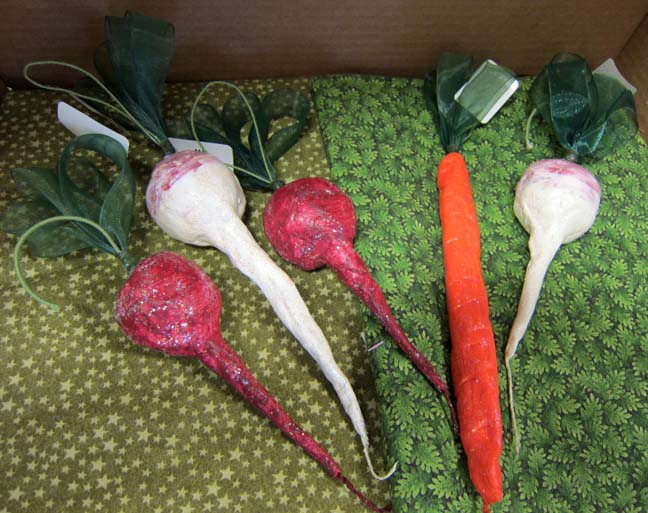
Garden Veggie Ornaments beautifully remind us to eat our veggies all year long.

Knitted Hats, some with fruit and vegetable themes, keep little heads toasty!

Decorative Storage - Beautiful and useful!


These hand-made chickens can keep you company all year long...

Keep recipes, newspaper clippings, and thoughts tidy in these embellished journals.


We'll also have jewelry, clothing, eye masks, soaps and plenty of other goodies. So please mark your calendars and bring a friend out with you. We look forward to seeing you Saturday at the Gardens.
Here are some more teaser pictures!


Wednesday, October 26, 2011

New Facebook Photo Contest: Fall Colors

The Virtue Peace Pond in fall. Photo by Rick Fisher.

Have you seen the beautiful oranges, reds and yellows peeking through the greens here at Duke Gardens? It's a perfect palette for a new photo exhibit+contest on our Facebook page (or see all entries). Got a favorite Duke Gardens photo featuring fall colors? We'd love to see it. Please don't be shy. This exhibit & contest is open to photographers at all levels and all ages. It's just a fun way to share your love for the Gardens with others who love it here, too.

For this contest, the fall colors can be anywhere, from a leaf to a flower, even a coat or hat -- as long as the setting is here at Duke Gardens.

Note: Facebook's structure has changed, so we can no longer do the contests in "events" with ease. So now we're using a collective album and email, which seemed to work well for our water plants contest.

Here's the scoop:

TOPIC: The topic for October/November is fall colors.

HOW TO ENTER: Email up to 3 photos for each contest to DukeGardensPhotos@yahoo.com. At least 5x7" or larger at 72 ppi is best, but if you don't know how to resize photos, feel free to send them as is, 1 per email. We will post them in an album on Facebook, with your Facebook name in the photo description. You can then add more information about the photo if you like, and encourage your friends to come see it and vote. You may also post the photo on our wall, but be sure to email it as well, so that it's officially in the contest and album. Only "like" votes and comments on the album photos will count in vote tallies.

DEADLINE: Photos must be submitted by Nov. 28. Voting will end at our amended cutoff of 10 a.m. Dec. 1.

PRIZES: We'll have prizes for most "like" votes and comments, as well as judges' awards. First prize is a Duke Gardens 2012 calendar. 2nd prize: Duke Gardens greeting cards or a 75th anniversary T-shirt. 3rd prize: discount coupon for the Terrace Shop. Entrants may only win one prize per contest theme in each tally (top votes & judges' prizes).

SHARE: Even if you're not interested in prizes or contests, we'd love for you to share your photos just for fun. We look forward to seeing your favorites.

LEARN MORE: Please check out our education & event listings for photo courses that you may enjoy. We also have a Nature Photography Certificate program that may interest you.

Thursday, September 29, 2011

Plant Sale & Fall Planting Tips

Our Fall Plant Sale will enhance
your garden year-round


By Kate Blakely

For all kinds of gardens, from vegetable to trees and shrubs, fall is best for planting. And the key in successful planting is in the roots. As plants go dormant in colder weather, they focus on their roots systems. Even planting in winter can work well, so long as the ground isn’t frozen and the plants receive proper care. Then, come spring, fall plantings will be already in the ground, ready to go.

We’ll have a wide range of plants available at our Fall Plant Sale Saturday from 9 a.m. to noon at Duke Gardens. Our horticulturists will also be on hand with expert advice. To start you on your way, horticulturist Michelle Rawlins offers a few fall planting tips below.

Soil Preparation: “Soil prep is your first task that you want to focus on when you’re starting a new bed,” says Rawlins. First, dig a hole a bit larger than the pot the plant came in. Make sure to break up any clay or compacted soil to allow proper drainage for your new plant. Add two to three shovel scoops of composted material to the soil you have removed from the hole. Blend all of this soil well. Remember, the key is in the roots, and having good soil is important.

“Compost does improve the quality of your soil and will produce a healthier specimen in your garden,” says Rawlins.

Planting: If the plant has been sitting in the pot for a while, it’s probably “root-bound.” Plants are usually initially grown in a soilless material along with PermaTill or vermiculite. These types of media make it really easy for the roots to grow. Inside a pot, fast-growing roots circle each other, forming a “root-ball.”

“If you don’t break the roots up, they’ll just continue to circle as if they’re still in the pot instead of in the ground,” Rawlins said. You need to break apart the root-ball gently before you plant.

“The hole should be no deeper than the root-ball,” Rawlins says. “If anything, you want to plant it about an inch or so higher than ground level, because the newly worked soil will settle, and if the plant’s too low, it has little success of thriving or even surviving.”

Cover any exposed root-ball with mulch. Rawlins recommends triple-shredded hardwood.

Watering and Fertilizing: Water the plant in well. Keep an eye on the plants for signs of thirst, like flagging or drooping. “They’ll let you know,” Rawlins says.

Be careful not to over-fertilize. “You don’t want to promote too much root growth in the fall,” Rawlins says. “You don’t want to push your plants too hard because of the threat of freezing.”

“Fall is a nice time to plant because you don’t have to water them every day,” Rawlins concluded. “The cool nights will be optimum for keeping your plant from too much stress or transplant shock.”

We’re happy to offer more advice at our Fall Plant Sale Saturday. And if you want first dibs, consider joining Friends of Duke Gardens to attend the 8 a.m. pre-sale (Friends info: 668-1711); you can join on site. Parking is free. The sale will feature bulbs best planted in (you guessed it!) the fall, as well as flowers, trees, vines and shrubs found throughout Duke Gardens all year. Read a more detailed preview in our previous post.

Sarah P. Duke Gardens creates and nurtures an environment in the heart of Duke University for learning, inspiration and enjoyment through excellence in horticulture. The Gardens is at 420 Anderson St. Visit online at gardens.duke.edu, or call 684-3698. For more information on Duke Gardens events, please see our education & events page, or read our quick blog roundup.

Kate Blakely is a graduate student at Duke Divinity School and a work-study assistant at Duke Gardens.

Tuesday, September 20, 2011

Fall Plant Sale preview

Toad lily is among the plants you can buy
at Duke Gardens' Fall Plant Sale


Gardeners often head to their local public gardens not just to immerse themselves in the beautiful and peaceful surroundings but to draw up blueprints for success in their own yards.
What plants thrive in this region? Which ones make interesting combinations, in terms of color and texture? Which fare better in full sun than one might think, or do surprisingly well in shade?

At Duke Gardens’ biannual fundraising plant sales, they can put those lessons into action, with guidance from the horticulturists and curators who know the plants best.

The Gardens’ Fall Plant Sale, from 9 a.m.-noon Oct. 1 (with an 8 a.m. presale for Gardens members -- info: 668-1711), will feature flowers, vines, trees and shrubs found throughout Duke Gardens, as well as bulbs best planted in fall for spring delights.

We won’t have any outside vendors at this sale, though you can expect them back at our larger sale next spring. Instead, we’re going to free up the lower parking lot for customers’ convenience and hold the sale on the lawn behind the Doris Duke Center. Parking is free.

Jason Holmes, who is curator of the Doris Duke Center Gardens and coordinates the plant sale, offered a few highlights.

Chinese leadwort: This unusual perennial has brilliant cobalt blue flowers and makes a great ground-cover, Holmes says. It likes full sun. Once established, it also tolerates drought well. It blooms in mid-summer through fall.

Chinese leadwort

Toad lily cultivars: This shade-loving, spreading perennial grows to between a foot and 2 feet high. In late summer, it produces brilliant little flowers about the size of a quarter, which are unusual in shape. They’re often white with purple spots. “They’re a nice little novelty plant,” Holmes says.

Propagated plants: Customers are especially fond of the plants propagated directly from Duke Gardens by the volunteer propagation team, so it’s best to arrive early if you’re hoping for these special mementos. The prop team takes requests, too, so speak up if there’s something you’d like to see at next year’s sales.

Gardening books: Thanks to a large and generous donation from a Duke Gardens supporter, our used book sale will be extra big this year. Most books will cost $.50 to $1.

Bulbs: We’ll also have plenty of bulbs, which are best planted in fall but are often a hard sell because they’re not attractive in their bulb state, Holmes says. He encourages people to embrace delayed gratification so they can be rewarded with spring blooms.

“How do they start,” he asks, “if not from a bulb?”

Among the bulbs you can expect to see:

Drumstick allium: These purple balls of flowers towering atop stems like something from a Dr. Seuss book are one of visitors’ favorite plants.

“Those bloom in May around here, but the fall is the absolute best time to plant them,” Holmes says. “Many people are always asking about getting this plant when it’s in bloom, but that’s not the good time to plant it. And it’s usually only available for sale during the fall season.”

Allium. Photo by Alice Le Duc

Colchicum: Known as autumn crocus, colchicums produce a profusion of 2- to 3-inch flowers in pink, white and purple.

“The foliage comes up in the spring, and it typically dies down, and then late summer to early fall is when the flowers come up out of the ground,” Holmes says. “So they’re almost like a surprise.”
Colchicum pannonicum 'Mauve Wonder'

Lycoris: These are also known as the surprise lily, hurricane lily or spider lily, and we expect to have them in red, pink and yellow. You can see some of the red and yellow versions in the Culberson Asiatic Arboretum. The pink – also known as “Naked Lady” – blooms a bit earlier and was featured in the Terraces this year. It grows taller and is more robust than the other colors.

Golden spider lily

“In the spring months you’ll have the foliage come up, and then, much like the autumn crocus, the foliage dies down in early fall,” Holmes says. “In late summer or early fall, you have a giant spike come out of the ground that may contain as many as 20 flowers. It radiates out like a spider. … They’re a real neat oddity in the garden that you don’t really find elsewhere. They’re something for true gardeners to have.”

Hurricane lily

Sarah P. Duke Gardens creates and nurtures an environment in the heart of Duke University for learning, inspiration and enjoyment through excellence in horticulture. The Gardens is at 420 Anderson St. Visit online at gardens.duke.edu. For a brief roundup of events through December at Duke Gardens, please see this blog post. For further information, please go to our education & events page.

This column first appeared in the Durham Herald-Sun. All photos are by Jason Holmes, unless otherwise noted.

Tuesday, September 13, 2011

Free outdoor film: "Play Again"


Nurturing with Nature

One generation from now, most people in the U.S. will have spent more time in the virtual world of electronic devices than in the nature, according to filmmaker Tonje Hessen Schei.

Currently the average American child can name hundreds of corporate logos but fewer than 10 native plants.

Distressed by this trend, Schei set out with her camera to investigate. She spoke with youngsters about their digital obsessions and brought them a wilderness adventure—unplugged from it all.

The result is “Play Again,” an award-winning documentary that Duke Gardens will present Sept. 15 at dusk (around 8 p.m.) as part of the Movies in the Gardens at Twilight free movie series on the lawn behind the Doris Duke Center.

Through the voices of these children and leading experts, “Play Again” investigates the consequences of a childhood removed from nature and encourages action for a sustainable future. Thursday’s viewing is a co-production with Duke’s Nicholas School of the Environment.
Schei discussed the film with Duke Gardens’ Flora magazine in an e-mail conversation.

What triggered this project?
The idea for the film started in 2005, when I came across a study that showed that kids today can recognize more than 100 corporate logos and fewer than 10 plants in their own back yards. This is very concerning to me, and I think there are serious consequences to kids growing up removed from nature.

Was your own childhood nature-centered?
I grew up in Norway, roaming in the woods all year ‘round. Rain, snow, sleet—you name it, we were outside. This is a stark contrast to how my children are growing up. I would be lost without nature. It is where I find meaning and inspiration. It is where I find perspective and peace. To me the issues of “Play Again” are at the core of who we are, why we are here and where we are going.

Were there any surprises for you in what transpired with the children?
I was very impressed and moved by the transitions the teens went through during the film. Something strong happens when you swim in a river, hike and dig in the dirt for the first time. For some it was very stressful to be outside and active, and some felt lonelier being with a small group of people rather than in front of their computers with their gaming and Myspace communities.

Was there one activity outdoors that had a particularly strong effect on them?
I think swimming in the river for the first time had a strong impact on many of the teens. Starting a fire from scratch and making their own bow and arrow were some of their other favorite activities.

Do you think most children have an innate connection with nature and they only need exposure, or does nature appreciation typically need to be taught to a child?
I do think that people need nature. It is who we are and where we come from. And I think that in our virtual-media-immersed culture we as adults and parents need to think about how we introduce nature to our children—and how we prioritize our time. We are so busy, and we tend to schedule all of our children's time with activities and "enhancements." It is hard to make it out to nature in our daily lives. I think we need to take a hard look at how we live and spend our time. When we do go outside with our kids, I think it is crucial that we inspire the sense of wonder, which very often just comes from playing and discovering our natural surroundings.

What do you think public gardens or parks ought to consider with regard to children’s relationship with nature?
Too often to we think of nature as wilderness and an exclusive activity. Nature is all around. Our backyards, our neighborhoods and parks. I do think it is crucial that we find and reclaim natural places where we allow our children to play freely.

Have you followed up with the children in the film?
Yes. We have become very close to the teens in the film, and many of them travel with the film and speak on these issues publicly. We are very proud of them; they are amazing kids and great spokespeople for their generation.

What did you hope to achieve with “Play Again”?
In making this film, it was crucial for us to learn about these issues from the children, to understand where they are coming from and what they are up against, and most importantly to give them a voice through “Play Again.” With “Play Again,” we want to put these issues on the forefront of people's minds, start discussions and encourage change. The film asks important questions and offers solutions to this issue that aim to encourage our audience to action for a sustainable future.

INFO: For more information on the film, and a trailer, please go to http://playagainfilm.com. For information on parking and other logistics, please see Duke Gardens' film page.

Tonje Hessen Schei

Thursday, September 8, 2011

Class preview: Create stone leaves or planters

Cast stone leaf by Duke Gardens student Lu Howard

Gardeners are inventive people and always look for new methods to display their favorite plants. Creating a stone casting from a beautiful leaf or building your own rustic stone planter is one way to preserve or display a grouping of plants.

Stone leaves, cast directly from a leaf set in concrete, may be displayed as sculpture or functional art, such as a birdbath. Whether rustic or painted, the casting can be displayed indoors or out in your garden.

Rustic stone planters, cast from a lightweight concrete mix called hypertufa, resemble the antique stone sinks that are used so effectively as planters in England.

Hypertufa is a mix of sand, peat moss and other elements, says Beth Jimenez, of Lasting Impressions Concrete Sculptures.
Hypertufa planter by Lu Howard

Jimenez will teach two hands-on classes with business partner Amelia Lane on Saturday, Sept. 17, at Duke Gardens. “Cast Stone Leaves” will be from 10 a.m. to noon, followed by “Artificial Stone Sculptures and Pots: Hypertufa” from 1 to 4 p.m. The classes are for students at all ability levels.

You don’t need a large garden to incorporate hypertufa, Jimenez says. “Creating and gardening in hypertufa trough containers allows those with limited space to garden on a small scale and those with larger spaces to use the trough as the perfect planting container for a special plant or collection of small plants.”

For the cast stone leaves, large leaves such as hosta, colocasia and alocasia work especially well.

“Big is good when it comes to this,” Jimenez says, noting that narrow, pointy leaf tips can break easily when molded. “You wouldn’t want to use a fern or anything that is too finely textured.”

Cast stone leaves by Lu Howard

Students need not have special artistic abilities to create a leaf or hypertufa container. Everyone has ideas that Jimenez can help them realize.

“Everybody works differently and everybody has a unique way of showing their own way of creativity,” Jimenez says. “We love the process of watching people be creative. … There’s an excitement that builds during the workshop when the participants begin to share their thoughts and ideas about how the finished piece of art should look.”

Students especially enjoy imagining the plants they’ll put in their containers once they’re cured and ready to use.

“There are so many different options for shade plants, sun plants, little trees, little bitty shrubs, mosses, you can do sedums – the sky’s the limit,” Jimenez says. “It’s so much fun thinking about what you want it to look like when it’s fully planted.”

INFO: For more information or to register, please call 668-1707 or email slsmith@duke.edu. You can also read about this class and others in our full education and events program guide at gardens.duke.edu.

Sarah P. Duke Gardens creates and nurtures an environment in the heart of Duke University for learning, inspiration and enjoyment through excellence in horticulture. The Gardens is at 420 Anderson St. Crystal Cotton, a junior at N.C. Central University and summer intern at Duke Gardens, contributed to this column. Photos by Lu Howard. This column first appeared in the Durham Herald-Sun.