Showing posts with label children. Show all posts

Tuesday, April 12, 2022

Enjoy Easter & Spring at Duke Gardens


Enjoy tulips and more during your spring visit
to Duke Gardens. Photo by Karen Webbink.

Easter egg hunts are great fun in your home, but they can create problems in Duke Gardens. We want to remind visitors that Easter egg hunts are not permitted in Duke Gardens, and to offer some fun ways for visitors—particularly youngsters—to celebrate Easter and enjoy all springtime visits together.


Why no Easter egg hunts at Duke Gardens? We ask visitors to refrain from egg hunts so that we can keep the fragile plants in this botanic garden safe from excited little hands and feet searching high and low for eggs and candies. We also ask visitors to help protect wildlife, so animals and birds won't try to eat the large number of forgotten eggs and candies later. Many people are unaware that chocolate can be especially harmful to dogs, and we want our visiting dogs to be safe, too. (In related news, please note that dogs are only permitted at Duke Gardens before 10 a.m. or after 5 p.m. More info here.)

What to do instead? We'd love to hear your ideas. Here are some of ours:

* Play a game of Search with Your Eyes (not hands, please): Kids can have lots of fun looking all over the Gardens for signs of spring, from new buds to colorful blossoms. How many times can they find their favorite color? How about familiar shapes that appear in leaves and flowers? How many circles, triangles or squares can you find? If you visit our information desk before heading out into the Gardens, we'll give you a free Scavenger Hunt for young visitors to follow.

Explore the Discovery Garden to see blueberries, kale, chard, peas, mustard and other yummy foods being grown. For children who've only ever seen these foods on a plate or in a grocery store, seeing where the plants are "born" can be fun. Families can also visit the chickens in the Discovery Garden, so children may see where real eggs come from. The produce from this garden benefits local families through partnerships with Healthy Families Durham and the Food Bank of Central and Eastern North Carolina.  Please do not pick any part of these plants. We ask that you leave them for others to enjoy and learn from, and for the benefit of our community partners.

Fun activities to print out in advance: Plan your family visit ahead of time with our self-guided family resources.

Bird watch: From a great blue heron to a red-tailed hawk and many other species, lots of birds will be enjoying the spring weather in the Gardens this weekend. How many different birds can you spot? Any you've never seen before? Check out the informational signs at the Asiatic Arboretum Pond or the Bird Viewing Shelter in the Blomquist Garden of Native Plants, and you can write down species names to learn more about when you get home.

* Shutterbug Madness: We'd love to see your favorite photos that celebrate spring in Duke Gardens. Please share them on our Facebook page, on Instagram (@sarahpdukegardens or tag #dukegardens) or email them to dukegardensphotos@yahoo.com.

*Easter Sunday Service: Join Duke Chapel Sunday for a 6:30 a.m. Easter Sunrise Service on the South Lawn of Duke Gardens. If you're coming for the sunrise service, please don't forget to bring a flashlight to help find your way to the lawn in the morning darkness, and a towel to wipe the dew from your chairs. If it rains, the services will be in Duke Chapel.

Thank you for joining us in celebrating spring and protecting the plants and animals that we all love.

Sarah P. Duke Gardens creates and nurtures an environment in the heart of Duke University for learning, inspiration and enjoyment through excellence in horticulture and community engagement. Duke Gardens is at 420 Anderson St.

Thursday, April 18, 2019

Fun Alternatives to Easter Egg Hunts

Families love to explore Duke Gardens together.
Photo by Bill Snead.

Easter egg hunts are great fun in your home, but they can create problems in Duke Gardens. We want to remind visitors that Easter egg hunts are not permitted in Duke Gardens, and to offer some fun ways for visitors—particularly youngsters—to celebrate Easter and enjoy all springtime visits together.

Why no Easter egg hunts at Duke Gardens? We ask visitors to refrain from egg hunts so that we can keep the fragile plants in this botanic garden safe from excited little hands and feet searching high and low for eggs and candies. We also ask visitors to help protect wildlife, so animals and birds won't try to eat the large number of forgotten eggs and candies later. Many people are unaware that chocolate can be especially harmful to dogs, and we want visiting dogs to be safe, too.

What to do instead? We'd love to hear your ideas. Here are some of ours:

Explore the Discovery Garden, a sustainable, organic food garden, to see fruits, vegetables and herbs getting their start for the season. You can also learn a lot about Earth science, chickens, and bees! We have lots of bee houses in the garden, and also a new bee observation hive where you can safely peer at the bees at work.
New bee observation hive at the Burpee Learning Center. Photos by Nick Schwab.

* Play a game of Search with Your Eyes (not hands, please): Kids can have lots of fun looking all over the Gardens for signs of spring, from new buds to colorful blossoms. How many times can they find their favorite color? How about familiar shapes that appear in leaves and flowers? How many circles, triangles or squares can you find? If you visit our information desk before heading out into the Gardens, we'll give you a free Scavenger Hunt for young visitors to follow.
From beehouses to flowers, there are many cool shapes to observe throughout the Gardens.
Photos by Nick Schwab and Cathi Bodine.

Fun activities to print out in advance: Plan your family visit ahead of time with the activities on our Self-Guided Garden Resources webpage.
Great blue heron and ducks.
Photo by Jordan Montgomery.


Bird watch: From a great blue heron to a red-tailed hawk, ducks and many other species, lots of birds will be enjoying the spring weather in the Gardens this weekend. How many different birds can you spot? Any you've never seen before? Check out the informational signs at the Asiatic Arboretum Pond or the Bird Viewing Shelter in the Blomquist Garden of Native Plants, and you can write down species names to learn more about when you get home.

* Shutterbug Madness: We'd love to see your favorite photos that celebrate spring in Duke Gardens. Please share them on our Facebook page or on Instagram (tag us at #dukegardens).

*Easter Sunday Service: Join Duke Chapel Sunday for a 6:30 a.m. Easter Sunrise Service on the South Lawn of Duke Gardens. Please don't forget to bring a flashlight to help find your way to the lawn in the morning darkness, and a towel to wipe the dew from your chairs. If it rains, the services will be in Duke Chapel.

Thank you for joining us in celebrating spring and protecting the plants and animals that we all love.

Sarah P. Duke Gardens creates and nurtures an environment in the heart of Duke University for learning, inspiration and enjoyment through excellence in horticulture and community engagement. Duke Gardens is at 420 Anderson St.

Wednesday, October 4, 2017

Classroom Open Hours teaches children and parents


Classroom Open Hours includes access to our nature museum.
Photo by Sheon Wilson
By Sheon Wilson
Publications Coordinator

A 2-foot-long wasp’s nest, beaver and coyote skulls, brilliant feathers from an Amazonian parrot—it’s not every day that a child encounters such unusual study tools.

But at Duke Gardens’ weekly Classroom Open Hours, homeschool children and parents can gather for unique hands-on scientific adventures in an exciting learning laboratory.

The open-ended sessions—which run from 1 to 3 p.m. on Tuesdays through Nov. 28 and then resume from Jan. 16 to Feb. 27—give parents and children access to nature-related lesson plans, curriculum aids, microscopes, science-themed books, and a wide variety of unusual specimens and artifacts they probably don’t have at home.

“The classroom hours allow us to nurture learning and discovery in a manner that would otherwise be abstract,” says Cheznee Johnson, whose son, Harrison, attended nearly every session last year.

“Harrison has such a curiosity and interest in the world around him and how things work,” she says. “Every Tuesday he gets to see and experiment with all sorts of new and different things in the classroom.”

The sessions are unstructured so children and adults are free to explore the curiosities and find what piques their interest.

“We see it as a great way for families who can’t devote a room to all the things we have collected to have access to our resources, plus our teaching experience,” says Kati Henderson, a staff assistant in children’s education at Duke Gardens.

It's not every day you see a paper wasp nest up close.
Photo by Sheon Wilson
“Some parents have really enjoyed the experiments we do and have said, ‘Thank you for setting this up, because I wouldn’t have done this at home since it’s way too messy.’ ”

Parents struggling to create a lesson or activity for particular topics can ask the session leader for advice.

“We’ve made lesson plans for almost every discipline in our Garden programs,” Henderson says.

To prepare for a recent session, Henderson set up five tables. To appeal to preschooloers, she had materials for touching on one table, including a tub of sand and water.

Parents and children have many options to choose from
in Classroom Open Hours. Photo by Kati Henderson.
Another table had science magazines and old Duke Gardens calendars for making collages, along with an activity suggestion: Cut out a picture of an animal, create a habitat for it using more pictures and then collage them together. Nearby were boxes of cut branches for stacking and building structures. A fourth had a variety of leaves with drawing and dissecting materials for a hands-on nature study. And the table for parents had resources galore.

For students on school break, Classroom Open Hours can slow the brain-drain by infusing fun self-directed studies into their days off. It’s also popular for people seeking activities for visiting children.

“It gives the adults a bit of a break,” Henderson says. “They don’t have to choose the activity, gather the materials or plan the lesson. Because it’s drop-in, you can come when you want.”
Children love exploring our learning
lab. Photo by K. Henderson.

PROGRAM DETAILS:

DATES: Tuesdays through Nov. 28, and Jan. 16-Feb. 27

TIME: 1-3 p.m. Drop in anytime.

FEE: $3 per child per session; $40 per child or $120 per family for all sessions.

MORE INFORMATION: See our website to learn more about this and other programs for children and families, and to begin the registration process or ask questions. You may also call or email us directly at 919-668-1707 or gardenseducation@duke.edu.

Friday, March 29, 2013

Enjoy Easter and Spring at Duke Gardens

Visit the egg-laying hens at Duke Gardens

Updated for 2014

With Easter Sunday approaching, many families are looking forward to creating Easter egg hunts for children to enjoy in their yards. Others will head to Duke Gardens, hoping to bring their egg hunts to a larger space. We want to remind visitors that Easter egg hunts are not permitted in Duke Gardens, and to offer some fun ways for visitors—particularly youngsters—to celebrate Easter and enjoy all springtime visits together.

Why no Easter egg hunts at Duke Gardens? We ask visitors to refrain from egg hunts so that we can keep the fragile plants in this botanic garden safe from excited little hands and feet searching high and low for eggs and candies. We also ask visitors to help protect wildlife, so animals and birds won't try to eat the large number of forgotten eggs and candies later. Many people are unaware that chocolate can be especially harmful to dogs, and we want our visiting dogs to be safe, too.

What to do instead? We'd love to hear your ideas. Here are some of ours:

* Where did those Easter eggs come from? Why not visit the chicken coop in the Charlotte Brody Discovery Garden so children can meet some egg-laying hens? Baroness von Brody, Big Mama and her pals would love to greet you.

* Continue exploring the Discovery Garden to see broccoli, cauliflower, blueberries, kale, chard and other yummy foods being grown. For children who've only ever seen these foods on a plate or in a grocery store, seeing where the plants are "born" can be fun. The Exploration Station will not be available on Easter weekend 2014.

* Play a game of Search with Your Eyes (not hands, please): Kids can have lots of fun looking all over the Gardens for signs of spring, from new buds to colorful blossoms. How many times can they find their favorite color? How about familiar shapes that appear in leaves and flowers? How many circles, triangles or squares can you find? If you visit our information desk before heading out into the Gardens, we'll give you a free Scavenger Hunt for young visitors to follow. The Nature Ranger Cart will be taking a holiday for Easter weekend 2014 and will not be at the Gothic Gate.

* Bird watch: From a great blue heron to a red-tailed hawk, a black-necked swan and many other species, lots of birds will be enjoying the spring weather in the Gardens this weekend. How many different birds can you spot? Any you've never seen before? Check out the photos at the Asiatic Arboretum Pond or the Bird Viewing Shelter in the Blomquist Garden of Native Plants, and you can write down species names to learn more about when you get home.

* Shutterbug Madness: We'd love to see your favorite photos that celebrate spring in Duke Gardens. Please share them on our Facebook page or email them to dukegardensphotos@yahoo.com. On April 2, we'll draw a few names randomly to win some prizes.

*Easter Sunday Services: Join Duke Chapel for a 6:30 a.m. Easter Sunrise Service or an 11 a.m. Catholic Mass on the South Lawn of Duke Gardens. If you're coming for the sunrise service, please don't forget to bring a flashlight to help find your way to the lawn in the morning darkness, and a towel to wipe the dew from your chairs.

Thank you for joining us in celebrating spring and protecting the plants and animals that we all love.

Sarah P. Duke Gardens creates and nurtures an environment in the heart of Duke University for learning, inspiration and enjoyment through excellence in horticulture. Duke Gardens is at 420 Anderson St.

Tuesday, June 26, 2012

Nature journaling day camp for tweens

By Jan Little
Photo by Lauren Sims

Artists, gardeners, writers, scientists and others have kept journals in which they can jot notes, observations, ideas they want to explore and details to be drawn. Leonardo da Vinci’s journals are maintained in a number of museums around the world. In his journals he kept everything from grocery lists to sketches of helicopters!

Journaling is a way to focus your thoughts and explore a concept without losing track of ideas. For an artist, a journal provides a quick way to record a view or a detail for later use. Some artists work on small versions of a larger project in their journals first, searching for just the right composition to help them move forward on the full-size version.

Children ages 11 to 13 will have the opportunity to try out nature journaling in “Drawing on Nature,” two one-week Nature Adventures Camp programs in August. As a group, they will explore nature in the Gardens. Individually, they can record notes, sketches, ideas, poems and observations. The journal requires careful observation and helps develop a vivid understanding of nature, perhaps even a delight in your findings.

The children will be following a popular tradition. Thomas Jefferson maintained decades of garden journals in which he recorded a calendar of when seeds were sown and seedlings planted, the timing and amount of harvest, and plant evaluation. Those journals are still being studied and used by gardeners and researchers to understand gardening and landscaping in Jefferson’s time.

Chuck Hemric, Duke Gardens’ volunteer director and an avid gardener, maintains a garden journal that began when he moved to his home and garden eight years ago.  It helps him track types of plants, planting locations, the plant source, weather trends, and seasonal notes such as first bloom or first fruit.
“It helps me learn and remember what conditions work for a plant and determine just what is meant by part shade, full shade, so I can learn the conditions unique to my garden in which a plant will thrive,” he says.

Self-discovery is inevitable as you maintain a journal, and it will be fun to see what the youngsters who participate in “Drawing on Nature” will learn about themselves. The program will be guided by local artists and experienced journal-keepers, who will help the children pursue their own interests and hone their skills. The children need not have exceptional artistic or writing abilities to participate.

Camp dates & information: Drawing on Nature camp runs from 8:30 a.m.-1 p.m. Aug. 6-10 or Aug. 13-17 (children may attend both). Extended care is available from 1-4 p.m. The cost is $150 per child per week; $75 more per week for extended care. For complete information, please visit gardens.duke.edu or call 919-668-1707.

UPDATE: We regret to announce that we are canceling the journaling camp due to low enrollment. We thank the many families who filled our other summer camps to capacity, and we look forward to shaping another exciting camp season next summer. If there's a themed camp you would love to see offered, please feel free to suggest it to education coordinator Kavanah Anderson.

Sarah P. Duke Gardens creates and nurtures an environment in the heart of Duke University for learning, inspiration and enjoyment through excellence in horticulture. The Gardens is at 420 Anderson St.

Columnist Jan Little is director of education and public programs at Duke Gardens. This column first appeared in the Durham Herald-Sun

Friday, April 13, 2012

Free drop-in programs for families

Making music with "sound sandwiches"
at Family Fun Day

By Kate Blakely

Looking for a chance to enjoy the Gardens with your family? We love to see families visiting, learning and wondering together. Below are three activities for families coming up soon. From reading a story to performing a science experiment, kids and caregivers alike can learn together and create lots of good memories and maybe even a craft to take home and enjoy.

None of these activities requires registration. All are free.

Nature Storytime
1st Saturdays: April 7, May 5, June 2
3rd Thursdays: April 19, May 17, June 21
10:30-11:30 a.m.

Do you love curling up with a good book? Nature Storytime is a chance for children and their caregivers to come and hear a story read aloud outside in the Gardens. We’ll follow up the story with an activity that matches the theme of the book. Take advantage of the gorgeous weather and special seasonal splendors to enjoy some good learning and good literature. Visit the front desk of the Doris Duke Center to find out where to meet. You can find out the book and activity in advance on our website.

Nature Ranger Cart
Friday mornings in April, May and June
11a.m.-1p.m.

Young visitors to the Gardens can enjoy free activities at the Nature Ranger Cart. The cart is usually parked out by the dawn redwood tree near the foot of the Terrace Gardens, but visitors can always check in at the front desk of the Doris Duke Center to find out the exact location each Friday. Cart activities include books to read, nature-related crafts, even some do-it-yourself science experiments.

Family Fun Day
Sundays: April 15, April 29, May 6, May 20
noon-3p.m.

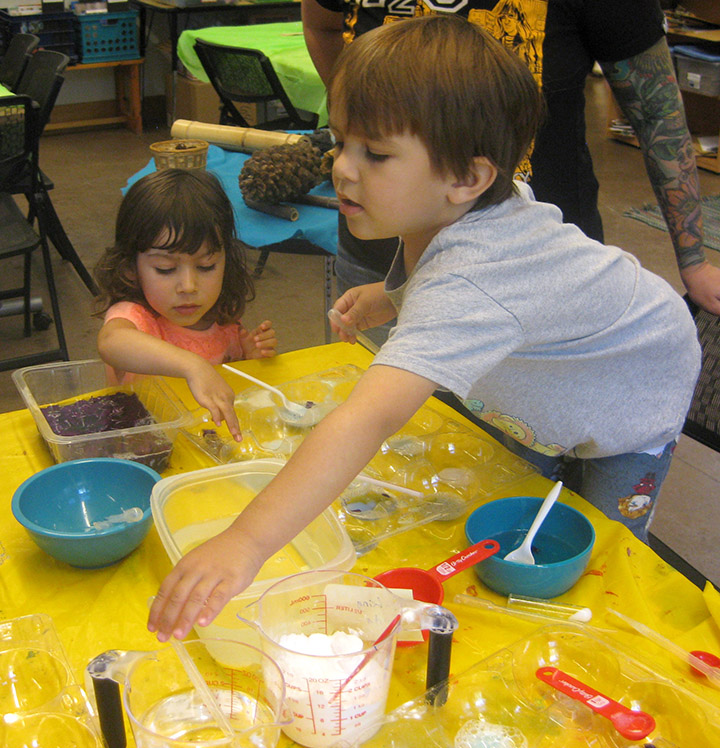
Want to make some slime? On Family Fun Days, activity tables with science experiments and nature-related crafts are set up in the Gardens. Create seed bombs, grape catapults or even “flying hoopsters.” You can probably guess what the first two are, but “flying hoopsters”? Come to these free events to find out how to make your own slime and just what “flying hoopsters” are!

Please dress appropriately for the weather. Don’t forget a hat or some sunblock, and maybe a water bottle. Also, please chaperone your youngest Gardens visitors. We love seeing families visiting together. Your visit will be so much more fun and rewarding that way.

Please read more here about new and returning programs for children and families.

Tuesday, April 10, 2012

New & Returning Children & Family Programs

By Kate Blakely

This time of year, inchworms seem to dropping from trees everywhere you look. Do they make you exclaim with excitement or shiver with fear? In a new class for kids, “Heroes and Villains,” we will learn about the ways these critters and more interact in nature.

“Heroes and Villains” is one of several exciting classes in the Children and Family series this spring. Most classes are new, but we will repeat some favorites, says Kavanah Anderson, education and programs coordinator. The topics will rotate seasonally.

When you are surprised by a spider, do you stand your ground or does it send you running? The argiope garden spider can be a formidable sight, with its size, striking yellow and black pattern, and zig-zag web. Beetles, earthworms, ticks, centipedes—these creatures all play a role in the natural world. Do you ever wonder what relationships they have with each other? Do they help or hurt each other? Come to “Heroes and Villains” and find out. The class is on Wednesday, April 25, from 2:30-4 p.m. It's for children ages 9-11.

A favorite from last year is “Drip Drop: Be a Raindrop for a Day,” coming up Saturday, April 28, at 10-11:30 a.m., for ages 7-9. As they say, April showers bring May flowers. From showers to flowers, water makes an incredible journey. Children can join us for a trip around the Gardens as we learn about the water cycle. We’ll study how and where rainwater travels, how gravity affects water’s journey, and how water drains through different types of soil. We’ll also conduct scientific experiments to study water’s movements.

Participants will learn how to make “rain in a bag,” a miniature water cycle they can take home with them. So get your imagination running, and come on out to the Gardens. We’ll all be raindrops for the day! Please don’t forget to register in advance.

Caregivers, make sure to come along for our family classes. We ask adult chaperones to accompany our youngest Gardens visitors. There’s an important reason behind this.

“One of the main motivations in our request for adult participation is to help caregivers develop a relationship with nature alongside their children so that they’re exploring nature together,” Anderson says. “Our hope is that this relationship continues beyond their time in the Gardens.”

All Children and Family programs are $6, or $5 for Gardens members. To register, please call 919-668-1707.

To read about all our educational offerings for adults and children, please see our website. To be added to our email list for classes and events, please email us with a request.

Thursday, December 8, 2011

Duke Gardens events: Jan.-Aug. 2012


Sarah P. Duke Gardens’ new education guide is now online. The PDF includes class descriptions, instructor information, meeting times/locations and fees for all classes between January and August 2012.
Below is a quick rundown of the season’s offerings, including page numbers where you can find more information. Please also see our education/events page with links to different types of classes and events and information about how to register.
As always, we welcome your feedback and suggestions for our enrichment programs. We hope to see you here soon!
Children and Family Classes
Mysteries of Magnetism (Feb. 25) – pg. 6
Nature’s Kazoos (March 10) – pg. 5 (canceled)
Nature Storytime: Free Drop-in Book Club (March 15, April 7, May 5, May 17, June 2, and June 21) – pg. 7
Wind World (March 24) – pg. 5
Nature Ranger Cart: Free Drop-in Activities (Fridays, April, May, and June) – pg. 7
Nature for Sprouts (Fridays, April 6-27 or May 4-25) – pg. 7
Feathered Friends (April 7) – pg. 5
Nature for Sprouts (Fridays, April 6-27 or May 4-25) – pg. 4
Nature Adventures Camp: CAMP OUT! (April 9-13) – pg. 8
Spring Family Fun: Free Drop-in Activities (April 15 & 29, May 6 & 20) – pg. 7
Heroes and Villains (April 25) – pg. 6
Drip Drop: Be a Raindrop for a Day (April 28) – pg. 5
Seed and Soil Olympics (May 5) – pg. 6
Awesome Amoebas (May 26) – pg. 6
Paperhand Puppet Intervention (June 10) – pg. 7. Canceled by the artists. Sorry.
Nature Adventures Camp: Become a Scientist (June 11-15) – pg. 8
Nature Adventures Camp: Treasure Hunters (June 18-22) – pg. 8
Nature Adventures Camp: Science of the Sun (June 18-22) – pg. 8
Nature Adventures Camp: Animal Homes (June 25-29) – pg. 9
Nature Adventures Camp: Animals in the Garden (June 25-29) – pg. 9
Nature Adventures Camp: Treasure Hunters 2 (July 9-13) – pg. 9
Nature Adventures Camp: Time Travelers (July 9-13) – pg. 9
Nature Adventures Camp: Drawing on Nature (Aug. 6-10 and/or Aug. 13-17) – pg. 9
Gardening and Horticulture
Ikebana International club (2nd Monday monthly) – pg. 24
Triangle Orchid Society (2nd Monday monthly) – pg. 24
Durham Garden Forum: “A Garden of Moss” (Jan. 17) – pg. 18
Planting the Landscape: Design II (3 Tuesdays, Jan. 17-31) – pg. 14
Plants of Distinction: Winter/Spring (Jan. 18, March 7, May 16, July 18) – pg. 14
Vegetable Gardening Through the Year (3 Thursdays, Jan. 19-Feb. 2; March 22-April 5) – pg. 15
Gardening with Herbs (Jan. 22; part of the Master Gardeners’ Extension Gardener Series) – pg. 19
Beekeeping for Beginners (2 Saturdays, Feb. 4-11) – pg. 15
Durham Garden Forum: “Great Perennials for the Garden Bed” (Feb. 21) – pg. 18
Native Plants in our Gardens (Feb. 26; part of the Master Gardeners’ Extension Gardener Series) – pg. 19
Spring Flower Walk in the Arboretum (March 9 and/or April 13) – pg. 13
Container Gardening (March 18; part of the Master Gardeners’ Extension Gardener Series) – pg. 19
Durham Garden Forum: “Herb Gardening” (March 20) – pg. 18
Historic Gardens Color Walk (April 5 and/or May 3) – pg. 13
Lecture: "Across the Pond: A Celebration of 300 Years of Anglo-American Gardening" (April 5) – pg. 16
Spring Pruning (April 7) – pg. 16
Durham Garden Forum: “Vegetables as Ornament” (April 17) – pg. 18
Durham Garden Forum: “Introduction to Plant Propagation” (May 15) – pg. 18
Japanese Gardens in the U.S.: Growing from Cultural Outreach to Community Restoration (May 15, 7-9 p.m.; newly added program).
Durham Garden Forum: “Garden Advice Fair” (July 17) – pg. 18
Durham Garden Forum: “Creating New Plants” (June 19) – pg. 18
Field Trips
Early Spring Jewels: Field Studies (March 31) – pg. 28
Local Flora: Spring (4 Saturdays, April 7, 14, 28, May 5) – pg. 29
Wildflowers and Waterfalls (May 11-13) – pg. 20
Hemlock Bluff (June 3) – pg. 21
Botanical Art and Craft
Moss Gardens in a Dish (Jan. 21) – pg. 25
Creating Your Own Bonsai Plant (Feb. 18) – pg. 25
Designing with Flowers (6 Saturdays, Feb. 25-March 31) – pg. 26
Spring Flower Basket (April 5) – pg. 25
Creativity and Choice: Floral Design Studio (canceled) – pg. 26
Terrarium (June 9) – pg. 26
Natural History
Walk on the Wild Side (Jan. 5, Feb. 2, March 1, April 5, May 3, June 7, July 5, Aug. 2) – pg. 13
Winter Botany (2 Saturdays, Jan. 21-28) – pg. 27
Human Impact on the Environment: The Ecology of Change (4 Wednesdays, Feb. 8-29) – pg. 27
Basic Botany and Plant Growth (4 Thursdays, Feb. 9-March 1) – pg. 28
Water: The Ecology of Change (4 Tuesdays, Feb. 21-March 13) – pg. 28
Early Spring Jewels: Field Studies (March 31) – pg. 28
Local Flora: Spring (4 Saturdays, April 7, 14, 28, May 5) – pg. 29
Bird Walks (April 7 & 28) – pg. 29
Nature Photography
Durham Photography Club (2nd Monday monthly) – pg. 24 (info on their Facebook page)
Digital Photography: Understanding Digital Camera, Camera to Computer & Photo Editing (3 Wednesdays, Jan. 18-Feb. 1) – pg. 31
Nature Photography Winter Workshop (Jan 28-29) – pg. 30
Introduction to Nature Photography (Feb. 10-12) – pg. 31
Photoshop for the Nature Photographer (3 Saturdays, Feb. 11-25) – pg. 31
Learn from the Masters (3 Saturdays, March 31-April 14) – pg. 32
Photographing Plants (2 Wednesdays, May 16 & 23, and Saturday, May 19) – pg. 32
Composition and Light (2 Thursdays, June 14 & 21, and Saturday, June 16) – pg. 32
Image Improvement Before Post-Processing (Saturday, June 23) – pg. 33
Photographing North Carolina (July 12, 7-9 p.m.; newly added program)
Japanese Tea Gatherings
First Voice of Spring Tea (Friday, Feb. 24) – pg. 34
St. Patrick’s Day Tea (Saturday, March 17) – pg. 34
Cherry Blossom Festival (Sunday, March 25) – pg. 34
Spring Blossoms Tea (Friday, April 13) – pg. 34
Children’s Day Tea (Saturday, May 5) – pg. 34
Special Events
Swing at the Gardens - swing dance (Saturday, Feb. 11)

Spring Plant Sale (Saturday, March 31, 8 a.m.-noon; Gardens member pre-sale, March 30)

Friday, August 26, 2011

Exploring nature with children

By Jan Little

Most of us live in some kind of building, one that we call home. But in a larger sense we live in the entire world. That world can be a mysterious place, or it can feel just like home. Imagine a child’s excitement when he can find evidence of animal and insect homes in his own back yard, or know which plants feed the butterflies. Families and children can learn together at Duke Gardens in a variety of classes for all ages.

Water is one of the topics we will explore in a class (pre-registration required) for children ages 6 to 8. Water is necessary for all life, but we rarely think about its source or the water cycle. Most children are surprised to learn that water is a limited resource; additional water is not being shipped in from outer space.
In the program “Drip Drop: Be a Raindrop for the Day,” we will consider how water moves around our planet, beginning by tracing its path in the garden. The children can imagine where they would go if they were raindrops, moving through the garden in drips and splashes or through small streams, watering the plants, and finally joining the ponds and pools before it moves beyond the Gardens’ borders.
Once we are in a watery frame of mind, we can then think about water as a transformer. Liquid, vapor, fog, ice, snow, sleet—how many forms of water can you think of? Regardless of its form, the water we sip today has been moving around this planet for a long time. The water in your cup could be the same water used by George Washington to cook his green beans, or Genghis Kahn could have washed his hands in those very same water molecules, or a dinosaur could have splashed through this water millions of years ago. Water doesn’t go away; it just transforms and moves around the planet over and over.
This class will include creating your own water cycle in a plastic bag, with a pond, land, and eventually a rainy sky for each child to take home and display on a window. All it takes to work is a sunny day.

Other programs to introduce your family to the magic of nature include free drop-in programs such as Nature Storytime and the science and craft activities offered during the four weeks of Fall Family Fun. During Fall Family Fun, you will have the opportunity to investigate the natural world in quick experiments or make a craft to take home. We will also have displays on different weekends of reptiles and amphibians or local wildlife.

Other classes this fall include an introduction to our animal neighbors in “Knock, Knock. Who’s There?” for ages 4 to 6. Their older siblings, ages 7 to 9, can track butterflies and dragonflies through the Garden, learning how these magical creatures partner with plants, in the program “Flying Flowers.”
Youngsters ages 3 to 5 can join us for a month of seasonal explorations in Nature for Sprouts. Children ages 8 and 9 can investigate the impact of trees and shade on temperature in “Shadow World,” and children ages 10 to 12 will complete a foraging experiment over two Saturdays in “Food Fight.” We end the season with the program “Shelter,” which explores the function of shelter as each child builds a shelter and then measures its effectiveness at managing wind, weather, and water.
INFORMATION: For all of these programs, you can get full information at gardens.duke.edu, including a PDF download of our entire July-Dec. events program (or see a quick list in this blog entry). To register, please call 668-1707 or write to slsmith@duke.edu.

Sarah P. Duke Gardens creates and nurtures an environment in the heart of Duke University for learning, inspiration and enjoyment through excellence in horticulture. The Gardens is at 420 Anderson St.
Jan Little is the Gardens’ director of education and public programs. This column first appeared in the Durham Herald-Sun.