Thursday, March 29, 2018

Spring Plant Sale Preview: Hostas

Hosta 'Island Breeze'
By Annie Yang
Duke T'20
Photos by Beth Hall

Hostas come in more than 2,500 different cultivars of different shapes, colors, sizes and textures, opening up an vast range of possibilities of integrating them into your garden. They can work well grouped together as background plants, but their exciting colors also make them great ornamentals.

These perennials are low-maintenance and usually live quite long. Hostas have a reputation for being shade plants, but the brighter the leaf color, the more sun it will require. In general, hostas require watering once a week at the soil and not on the leaves. Hostas are relatively pest-free—aside from slugs and the occasional deer—and they will also attract hummingbirds to your garden. There are thousands of hosta cultivars. Here are a few that we’ll be featuring at the 2018 Spring Plant Sale on April 7.

‘Dancing Queen’ 
Hosta 'Dancing Queen'
Unlike other yellow hosta varieties, ‘Dancing Queen’ keeps the excitement going and stays bright yellow all season long. Though hosta’s foliage is usually the star of the show, the mid to late summer blooms of pale lavender flowers are nothing to ignore!

‘Stained Glass’
The glossy gold leaves and green borders of this plant may remind you of the colorful designs on large stained-glass windows. Hosta ‘Stained Glass’ grows huge leaves and large, fragrant light purple flowers in the late summer. This cultivar is also more tolerant of sun than its cousins are.

‘Island Breeze’
The yellow centers and thick green margins of ‘Island Breeze’s’ foliage evoke a sense of tropical tranquility. When grown in darker shade, the yellows will become more chartreuses. But if exposed to more light, ‘Island Breeze’ will also lighten in color. It’s visually quite similar to its cousin ‘Stained Glass’, but an observant eye will notice that the leafstalks of ‘Island Breeze’ are also tinged in red.

EVEN MORE HOSTAS! Specialty hosta grower Green Hill Farm will also be a vendor at our plant sale. See additional specialty vendors at our plant sale link below.

SPRING PLANT SALE INFO:
Date: Saturday, April 7, 2018
Time: 8 a.m.-noon
Preview sale for members: Friday, April 6, 4-6 pm.
Membership plant sale benefit: Duke Gardens members get 10% off & a full list of plants in advance! Join online or on site.
Parking: Free.
Pets not permitted
Wagons + boxes: Our supply is limited; please bring your own if possible, and you'll have more time to spend gathering beautiful plants.
Your support helps Duke Gardens to provide summer internships to aspiring horticulturists from across the nation.
Please see our event page for more information, and we'd love for you to spread the word by sharing the event on Facebook and inviting your friends.
Thank you!

Wednesday, January 31, 2018

Making Botany Come Alive

Gain a deeper understanding of plant parts and their roles in "Basic Botany."
Photo by Bill Snead.
Lots of people like to garden, and many appreciate a beautiful garden design, but how many know exactly how plants manage water and nutrients? What makes them grow bigger flowers or juicier fruits? If you have ever wondered about these things, consider joining us for Alec Motten's "Basic Botany and Plant Growth" class beginning on Thursday, Feb. 15, from 6-9 p.m.

Motten is a distinguished associate professor emeritus in Duke's Department of Biology, and his passion and engaging way of teaching also made him a quick favorite among Duke Gardens instructors. You'll see why if you take his class. In the meantime, Motten offered some insights about himself and his love for plants in the following email exchange from 2016:

Alec poses with a beautiful friend.
Tell us about your background and experience.
I earned my Ph.D. in zoology at Duke in 1982 and received undergraduate degrees in botany from UNC-Chapel Hill in 1970 and in zoology from the University of Washington in Seattle in 1976. I've always straddled the line between traditional botanist and zoologist designations and consider myself an equal-opportunity natural historian.

My primary responsibility at Duke has been teaching undergraduates an array of courses, including introductory biology, organismal diversity, botany, ecology, and genetics and evolution. I've also taught writing for first-year students and senior biology majors. My research interests are in evolutionary biology, pollination ecology and plant reproductive biology.

For my doctoral dissertation I studied plant-pollinator interactions in the spring wildflower community of Duke Forest. I still consider March and April my favorite time to be in the woods, and I like to lead spring wildflower hikes to local natural areas.

In my spare time, I enjoy hiking, camping and canoeing. During travels in the U.S. and abroad, I look forward to opportunities to learn the local flora and fauna and indulge my interest in wildlife and nature photography.


Learn how plants manage water in response
to the environment. Photo by Orla Swift.
What can we expect from your class, and what do you hope participants will gain from it?
Students in the class will get a whirlwind tour of basic plant biology and learn how plants are put together, how they function, grow and reproduce, and how they interact in different ways with animals. Extensive, colorful handouts will be provided to help students follow along with the many different topics we'll cover.  I'll also bring in live specimens and lots of demonstration materials for hands-on activities and student personal observations.

Although any science class necessarily includes a certain amount of jargon, I'll keep that to a minimum and make sure to explain technical terms in language accessible to a non-specialist. My experience is that folks taking this class all have some interest in plants, often from a gardening or environmental conservation perspective, and my hope is to expand on that interest by helping students make connections with aspects of plant biology they are less familiar with. Plants are often taken for granted in our society -- they can be the unnoticed "wallpaper" of our world -- and I'd like to provide a deeper appreciation of just how amazing plant biology can be.

Learn how the structures of plants attract specific 
pollinators. Photo by Annabel Renwick.
What are you most excited about in this class?
In a time when much of academia is caught up in either increasingly narrowly focused topics or trendy multi/inter/cross-disciplinary studies, it is refreshing to teach a rather more traditional subject and help students delve into it with fresh eyes and new curiosity.  I always look forward to this opportunity to share my enthusiasm for botany with willing, interested students in a largely informal, relaxed setting -- no quizzes or papers! And, without a set curriculum to cover for an exam, I like being able to go off on botanically oriented tangents as student interests and unexpected opportunities may lead. The students and I always learn something new!

Motten's class meets for four Thursday night sessions, from Feb. 15 to March 8, from 6-9 p.m. If you are interested in learning more, please check out the class description for "Basic Botany and Plant Growth" on our website. To register, please call 919-668-1707 or send us an email. We look forward to seeing you!

This article is adapted from a 2016 post by Sarah Leach Smith.

Sunday, November 19, 2017

Fall Colors in Duke Gardens

The Woodland Bridge in the Doris Duke Center Gardens.
Photo by Clarence Burke.
By Sheon Wilson
Publication Coordinator

Fall colors are spectacular at Duke Gardens, and despite our dry summer, this year is no exception.

Visitors are marveling at the sugar maples (Acer saccharum) that flank the parking lot as they enter, and they're raving about the camellia flowers in the Culberson Asiatic Arboretum.

Japanese maple leaves.
Photo by Sue Lannon.


“They all comment, saying [the maples] are so pretty and the color is breathtaking,” says Sue Schneider, a Duke Gardens ambassador who greets visitors at the Gothic Gates. “And in the Asiatic Arboretum, the red bridge with the maples in the Japanese garden are spectacular.”

Schneider also volunteers in the arboretum, where fall visitors are often surprised by the blooming camellias.

“People who aren’t from this area say, ‘Wow, what is that?’ ” she says. “They can’t believe what they’re seeing.”

Seasonal color has peaked in western North Carolina, but deciduous trees in the Triangle weren’t in any hurry to put on their fall coats of yellow, orange and red in early fall. Now the show is on.
Fall's changing colors. Photo by Sue Lannon.
Each fall, changes in temperature and the length of daylight cause leaves to stop the food-making process in cells containing the chlorophyll. As chlorophyll breaks down, the green color disappears, and the yellow to orange colors become visible. The College of Environmental Science and Forestry in Syracuse, N.Y., offers a fuller explanation.

If that makes you want to learn more, check out classes at Duke Gardens that delve into plant life, including “The Winter Garden” at 2:30 p.m. Dec. 6, “Landscape Plants for North Carolina Gardens” in February, and “Basic Botany and Plant Growth” in February and March.

Ginkgo biloba.
Photo by Jason Holmes.
Horticulturist Michelle Rawlins has the perfect picture of fall in her head, and it involves the magnificent large maidenhair tree (Ginkgo biloba) in the Historic Gardens, planted about 50 years ago.

“A couple of years ago, there was a girl, probably about 5, in a red petticoat underneath the ginkgo, picking leaves up and throwing them in the air,” Rawlins said. “It was the epitome of perfect, and it's a mental picture that I carry with me.”

The ginkgo is one of Rawlins’ favorites because “it's a tree that turns gold one day, and then the leaves start falling, and it's raining fall color.” There’s still time this fall to see the tail end of the ginkgo’s golden display.

Camellias in
Pine Clouds Mountain Stream.
Photo by Sue Lannon.

Rawlins, a prize-winning chrysanthemum grower, also recommends checking out the numerous mums displayed throughout the Asiatic Arboretum. The diversity of color, shape, size and form makes these plants eternally fascinating.

“We've had a lot of good compliments on them,” she said. “It's a flower that's doing its thing when not much else is.”

Student perspectives: fall’s varied palette


Camellia sasanqua in the Culberson
Asiatic Arboretum.
By Annie Yang
Duke Class of 2020

One of the pleasures of returning to Duke Gardens time after time is that it is constantly evolving throughout the year. Every week I visit, the scenery gradually changes with the cycle of the seasons, and a new plant that has just started to bloom catches my eye.

More pretty camellias
in the Asiatic Arboretum.
Autumn is a chance for trees to play starring roles, their red, orange and yellow leaves creating brilliant fall vistas. But walk through Duke Gardens and you’ll see a wider palette than you may expect, with berries and blooms offering additional visual delights.

All around the Culberson Asiatic Arboretum are camellias (Camellia sasanqua), whose bright yellow stamen against vibrant pink and white petals are sure to catch your eye. This species of camellia also emits a pleasant fragrance, so keep your eyes and nose open while you walk through this part of the gardens.

American beautyberry
in the Asiatic Arboretum.
Near the edge of the Asiatic Arboretum, as well as in the Blomquist Garden of Native Plants and elsewhere in Duke Gardens, is a plant I initially mistook for grapes when I first encountered it. The bold purples of the berries hanging on these small shrubs certainly demand attention. It’s no wonder that this plant is called the beautyberry (Callicarpa americana). The berries cluster together along the branches, and it’s almost impossible not to be mesmerized by the deep purple hue.


Winterberry holly (Ilex verticillata) adds visual punctuation throughout Duke Gardens, including in the Asiatic Arboretum and the Historic Gardens. The small, bright red berries of this plant give a festive feeling to its surroundings and are a reminder that winter holidays are almost upon us!


Kohlrabi in the Charlotte Brody Discovery Garden.
The Discovery Garden was not a place I expected to see “showy” plants, but I was pleasantly surprised. I came upon kohlrabi, a vegetable bred from the wild cabbage plant.  A relative of kale, cabbage, broccoli, Brussels sprouts, and many other vegetables, this wild cabbage is stunningly versatile.

Kohlrabi can come in pale green or deep purple, and the bulbs grow above ground, its many stems appearing to shoot up from the soil. This is definitely not your average vegetable, and it definitely pops right out. It’s edible, too, as with everything in this sustainable, organic food garden, so it has both form and function.

On your next fall visit to Duke Gardens, stay tuned to the palette beyond the palette. Fall’s fiery leaves put on a spectacular show, but you may decide that some of their co-stars also deserve top billing.

Thursday, November 9, 2017

Fall for Orchids exhibit: an interview with Pei-Fen Liu

Visitors love taking photos of the wide variety of blooms
featured in the Fall for Orchids exhibit.
2016 exhibit photo by Kathy Julian.
By Sheon Wilson
Publications Coordinator

Musicians may know Duke instructor Pei-Fen Liu for her talent as a pianist. But this weekend at Duke Gardens, Liu will share another longtime passion: growing orchids.

Liu's blooms are part of the third annual Fall for Orchids exhibit, a collaboration between Duke Gardens and the Triangle Orchid Society. The exhibit opens Friday at 1 p.m. in the Doris Duke Center, with extended hours through 7:30 p.m. It will continue  through the weekend. Admission is free.

“Growing up in Taiwan, my mother grew all kinds of plants in our garden, orchids being one of them,” Liu, who has taught classical piano at Duke since 1994, wrote in an email interview this week. “She mounted Dendrobiums on tree ferns and hung baskets of Cattleyas behind shade cloths in the summer heat. The natural environment in rural Taiwan was pristine and we often took hiking trips in the mountains in search of wild orchids.”

North Carolina’s climate is also orchid-friendly, Liu says. So she and other orchid society members have ample opportunity to build and share their orchid-growing skills. 
Pei-Fen Liu with one of her orchids.
Photo courtesy of Pei-Fen Liu.

The exhibit will feature hundreds of stunning blooming orchids in lush garden-like settings, with displays by orchid societies from North Carolina and neighboring states. It will also include workshops and lectures about growing, repotting and caring for orchids (see schedule here), and visitors will have a chance to buy orchids and supplies.

Liu shared more about her love for orchids in the following Q&A:

What is the allure of the orchid? Orchids have always fascinated me with their diversity and endless variety. From the delicate blooms of the Phalaenopsis to the splash petals of peloric Cattleyas, orchid-growing is a hobby that never gets old. Each genre has its own appeal, and it has become an addiction to collect every single kind!                                                               

What orchid varieties do you grow?  I grow many varieties and have recently started to collect various species, particularly Dendrobiums. One of my favorites is Cattleya orchids; they can range from large and fragrant to compact and floriferous. Some of my favorites are Cattleya Sea Breeze, Cattlianthe Blue Boy and Rhyncholaeliocattleya Malworth ‘Orchidglade’.

What does it take to grow an orchid and keep it thriving? We are lucky to live in a climate that is both humid and warm enough to grow orchids outdoors in the summer. Finding the best medium, fertilizer and growing spot can take time, and I'm still trying to find better ways for my orchids to bloom bigger and healthier. It’s a giant learning curve but well worth making the effort.

What are some notable attributes of the orchid? What I find most interesting is that many species have different variations, which are typically expressed as a "var" at the end of their botanical names. This variation is usually a difference in color, but it also can be a splash in the petal or a different form in the flower. This variety in the orchid kingdom is passed down to hybrids, which has led to some amazing crosses.

Do orchids inspire your music, or does you music inspire your orchid-growing? Orchids and music represent each other.  I am inspired by both.

FALL FOR ORCHIDS EXHIBIT DETAILS

DATES: Friday, Nov. 10, 1-7:30 p.m.; Saturday, Nov. 11, 9 a.m.-5 p.m.; and Sunday, Nov. 12, noon-4 p.m.

COST: Free drop-in exhibit for all ages. Adult chaperone required. Parking fees apply Friday through 5 p.m. and after 1 p.m. Saturday and Sunday.

LEARN MORE: exhibit information; workshop & orchid society information.

Wednesday, October 4, 2017

Classroom Open Hours teaches children and parents


Classroom Open Hours includes access to our nature museum.
Photo by Sheon Wilson
By Sheon Wilson
Publications Coordinator

A 2-foot-long wasp’s nest, beaver and coyote skulls, brilliant feathers from an Amazonian parrot—it’s not every day that a child encounters such unusual study tools.

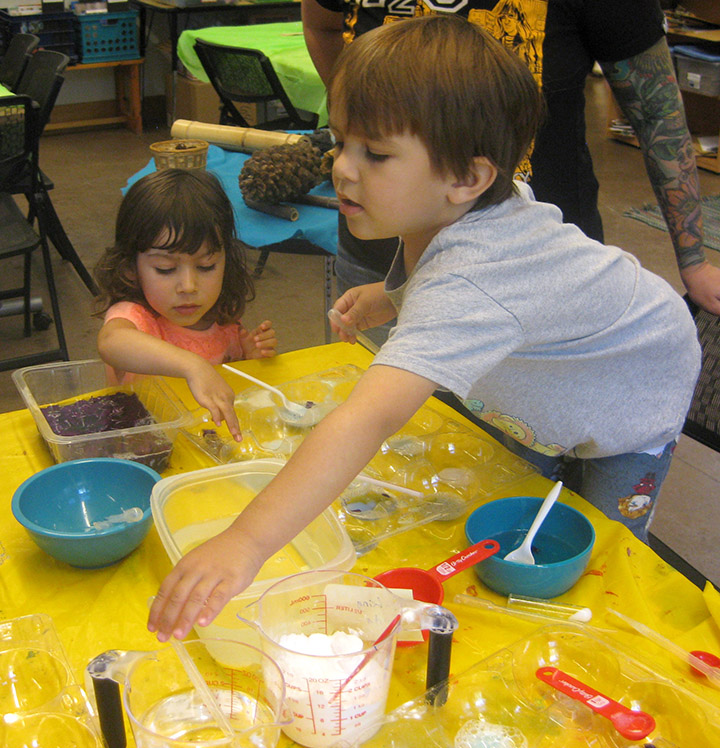
But at Duke Gardens’ weekly Classroom Open Hours, homeschool children and parents can gather for unique hands-on scientific adventures in an exciting learning laboratory.

The open-ended sessions—which run from 1 to 3 p.m. on Tuesdays through Nov. 28 and then resume from Jan. 16 to Feb. 27—give parents and children access to nature-related lesson plans, curriculum aids, microscopes, science-themed books, and a wide variety of unusual specimens and artifacts they probably don’t have at home.

“The classroom hours allow us to nurture learning and discovery in a manner that would otherwise be abstract,” says Cheznee Johnson, whose son, Harrison, attended nearly every session last year.

“Harrison has such a curiosity and interest in the world around him and how things work,” she says. “Every Tuesday he gets to see and experiment with all sorts of new and different things in the classroom.”

The sessions are unstructured so children and adults are free to explore the curiosities and find what piques their interest.

“We see it as a great way for families who can’t devote a room to all the things we have collected to have access to our resources, plus our teaching experience,” says Kati Henderson, a staff assistant in children’s education at Duke Gardens.

It's not every day you see a paper wasp nest up close.
Photo by Sheon Wilson
“Some parents have really enjoyed the experiments we do and have said, ‘Thank you for setting this up, because I wouldn’t have done this at home since it’s way too messy.’ ”

Parents struggling to create a lesson or activity for particular topics can ask the session leader for advice.

“We’ve made lesson plans for almost every discipline in our Garden programs,” Henderson says.

To prepare for a recent session, Henderson set up five tables. To appeal to preschooloers, she had materials for touching on one table, including a tub of sand and water.

Parents and children have many options to choose from
in Classroom Open Hours. Photo by Kati Henderson.
Another table had science magazines and old Duke Gardens calendars for making collages, along with an activity suggestion: Cut out a picture of an animal, create a habitat for it using more pictures and then collage them together. Nearby were boxes of cut branches for stacking and building structures. A fourth had a variety of leaves with drawing and dissecting materials for a hands-on nature study. And the table for parents had resources galore.

For students on school break, Classroom Open Hours can slow the brain-drain by infusing fun self-directed studies into their days off. It’s also popular for people seeking activities for visiting children.

“It gives the adults a bit of a break,” Henderson says. “They don’t have to choose the activity, gather the materials or plan the lesson. Because it’s drop-in, you can come when you want.”
Children love exploring our learning
lab. Photo by K. Henderson.

PROGRAM DETAILS:

DATES: Tuesdays through Nov. 28, and Jan. 16-Feb. 27

TIME: 1-3 p.m. Drop in anytime.

FEE: $3 per child per session; $40 per child or $120 per family for all sessions.

MORE INFORMATION: See our website to learn more about this and other programs for children and families, and to begin the registration process or ask questions. You may also call or email us directly at 919-668-1707 or gardenseducation@duke.edu.

Friday, September 29, 2017

Fall Plant Sale Preview: Woodland Phlox

By Rose James
Duke Class of 2020
Phlox divaricata 'Blue Perfume' is similar
to the 'Blue Moon' variety we'll have at
the Fall Plant sale. Photo by Jason Holmes.
Finding the right color of flowers for your garden can be difficult. I am particular to roses myself, but when it comes to purple and blue blooms, I have to turn to other options. Some of the prettiest shades of lavender I have ever found have come from the Phlox divaricata, commonly called the woodland phlox.

Ranging from lavender to blue, the Phlox divaricata is a small, native wildflower with dainty flowers that bloom in  April and May. It grows to be 8 to 12 inches high and equally as wide. It does well in partial shade to full shade gardens.

As an added bonus to its lush color, the woodland phlox is known to attract hummingbirds and butterflies. If left to grow in your garden, the woodland phlox will form large colonies over time, as wildflowers tend to do.

Woodland phlox in the Terrace Gardens. Photo: J. Holmes.


The Duke Gardens Fall Plant sale will feature the 'Blue Moon' Phlox divaricata, known for its deep violet-blue flowers. Its blooms are not only colorful but very fragrant. The 'Blue Moon' is a good complement for gardens with ferns and hellebores and is certain to please gardeners seeking to bring a variety of color into their gardens.

Fall Plant Sale details:

Date: Saturday, Sept. 30, 2017
Time: 8 a.m.-noon
Membership benefit: Duke Gardens members get 10% off! Join online or on site.
Parking: Free.
Pets not permitted
Wagons + boxes: Our supply is limited; please bring your own if possible, and you'll have more time to spend gathering beautiful plants.
Please see our event page for more information, and we'd love for you to spread the word on Facebook. Thank you!